One of the most common ways the spiritual ego hides is behind a single phrase: "I shouldn't have to want."
Many sensitive, deeply spiritual people have been taught that wanting things is an attachment. We learn to transcend desire, to be okay with whatever happens, and to view wanting as a sign that we are not fully surrendered. But there is a profound difference between surrendering to the flow of life and using spirituality as an excuse to avoid participating in it.
We see this often in our work. A practitioner will say, "I shouldn't have to want a successful business; if it's meant to be, the universe will provide." Or someone in a relationship will say, "I shouldn't have to ask for what I want; they should just know."
This is the spiritual ego at work. It uses spiritual concepts to justify stepping outside of our values and avoiding the vulnerability of co-creation.
When we met, one of the first deep conversations we had was about what it means to live a life without compromise. We realized that we both met as two people who do not compromise on any level whatsoever. That doesn't mean we don't appreciate the viewpoints of others or make space for them. It means we know what our boundaries are, and we know the kind of life we want to live.
The clearest definition of the ego is simply whatever comes between you and your values.
The ego always has a justification. It will say, "In this specific context, I had to act outside my integrity." It will use spiritual ideas to justify stepping outside those values. But your role in co-creation—being the one who desires your way in the direction of your highest alignment—is an essential participation.
What you want, and learning why you want it, is paramount to exploring who you are. Spiritually, we discover who we are not as a concept, but through the values we embody and live for.
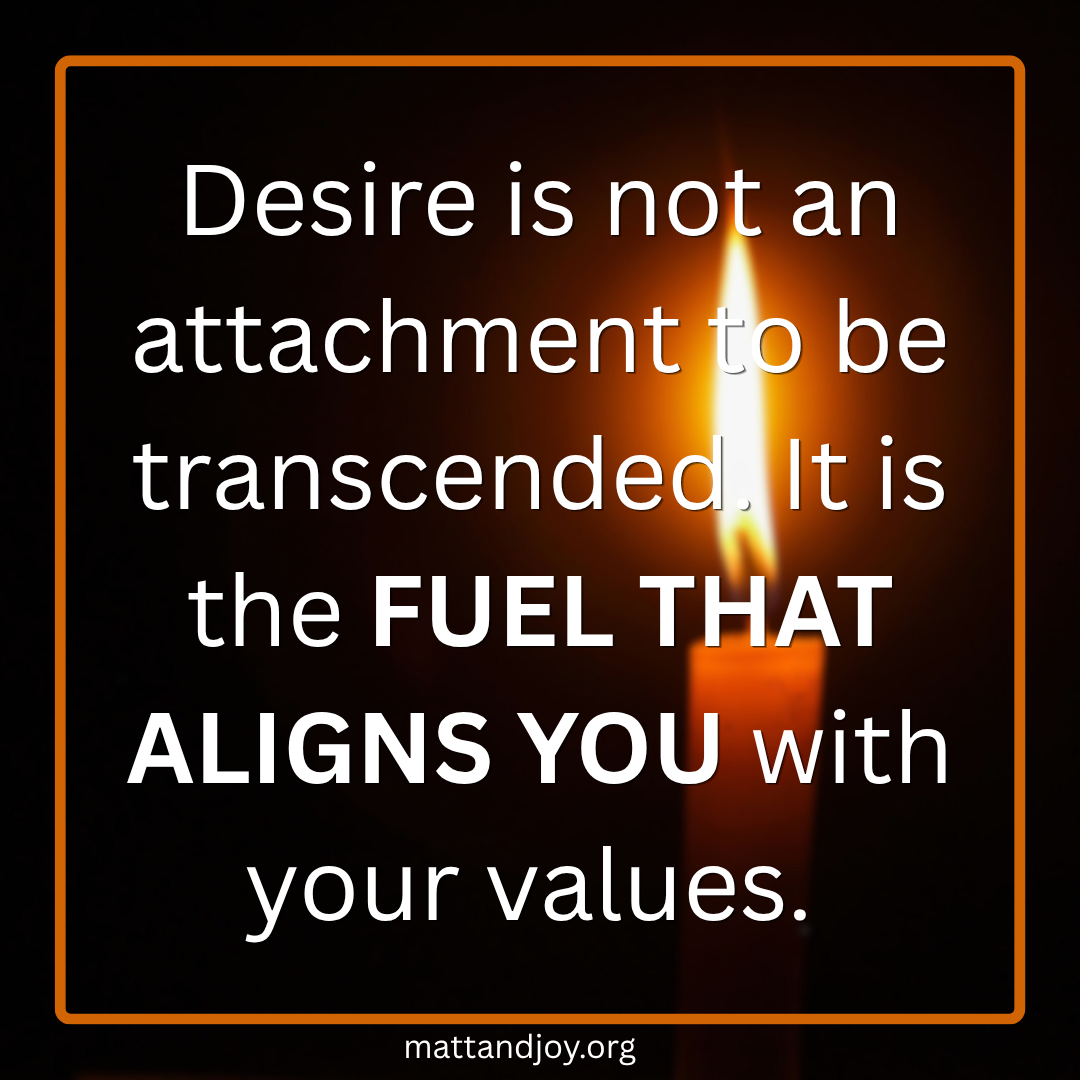
Desire is not an attachment to be transcended. It is the fuel that aligns you with your values. When you allow yourself to want an incredible life, and you choose that on a regular basis, you are not being unspiritual. You are stepping into your sovereignty.
But here is the deeper layer worth looking at honestly: most people are not actually afraid of desire. They are afraid of outcomes.
The real attachment is not to the wanting itself. It is to the expectation of what the wanting is supposed to produce. When we cannot guarantee the outcome, desire begins to feel dangerous. If we want something and it does not arrive the way we imagined, we interpret that as evidence that we were wrong to want it in the first place. So the mind makes a quiet agreement: if I never fully want, I can never fully lose.
This is where freeze and fawn patterns take root. Rather than stepping forward into a clear desire, we stall. We over-research, over-process, seek more opinions, wait for certainty that never comes. Or we fawn — we shape our wanting around what we think will be approved of, what seems safe, what will not disappoint anyone. In both cases, desire is not absent. It has simply been made smaller to protect us from the vulnerability of an uncertain outcome.
The invitation is not to detach from outcomes by pretending you do not care. It is to become someone who is willing to want fully, act from values, and remain open to how the outcome arrives — rather than whether it arrives at all. That is the difference between co-creation and control. And it is the difference between a life built on desire and a life quietly managed by fear.
Where in your life are you using a spiritual concept to avoid asking for what you truly want? And where might the real hesitation be less about the wanting, and more about the outcome you are afraid to lose?
If this teaching is stirring something in you, come be with us in person. There is a depth to live transmission that no newsletter can fully carry. We would love to see you on the road this year.
Upcoming 2026 Tour Dates:
👉 Encinitas, CA — July 18, 2026
👉 Mt. Shasta, CA (3-Day Retreat) — August 9–11, 2026
👉 Tampa, FL — September 19, 2026
👉 Berkeley, CA — October 24, 2026
👉 Portland, OR — October 31, 2026
👉 Phoenix, AZ — November 14, 2026
See all tour details and reserve your seat → tour2026.mattandjoy.org
With love,
Matt and Joy Kahn


Responses